
Here's a conversation BlackShark and I were having over at AVS. Neither of us completely get it, so I thought I'd appeal to you geniuses here:
xhonzi:
Why do (most) LCD projectors have R&B at 0 degrees and G at 90? Is that an intentional design decision? Is it the LCD panel itself that polarizes the light, or is there a separate filter in the light path? Assuming it's a separate filter- can the green filter be rotated to 0 degrees?
Why/How Green polarized at 90 degrees and R & B at 0?
-
xhonzi

- Binocular Vision CONFIRMED!
- Posts: 273
- Joined: Wed Mar 31, 2010 3:35 pm
- Location: Thornton, CO USA
Why/How Green polarized at 90 degrees and R & B at 0?
Last edited by xhonzi on Thu May 12, 2011 2:11 pm, edited 1 time in total.
-
xhonzi
- Binocular Vision CONFIRMED!
- Posts: 273
- Joined: Wed Mar 31, 2010 3:35 pm
- Location: Thornton, CO USA
Re: How does Green get 90 degrees off of R & B?
BlackShark on avs:
It's because of the internal structure of these LCD projectors.
Most of them are 3-LCD, which means there are 3 separate panels , one for each primary colour.
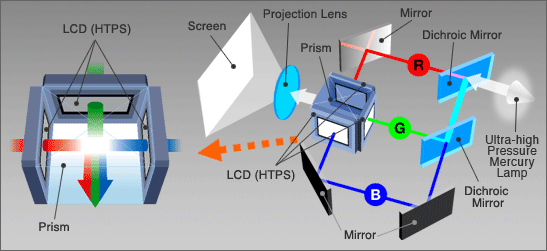
The LCD panels output polarised light (that's how LCD works), but then the 3 pictures are assembled by a set of mirrors and prisms, which modify the way the light is polarised.
LCoS also produces polarised light but since they're single panel (one panel produces all 3 primary colours) they're all polarised exactly the same way.
DLP produces non-polarised light
3-LCoS or 3-DLP could produce polarised light with different polarisiration for each primary colour, or not. It depends on how the picture is assembled.

-
xhonzi
- Binocular Vision CONFIRMED!
- Posts: 273
- Joined: Wed Mar 31, 2010 3:35 pm
- Location: Thornton, CO USA
Re: How does Green get 90 degrees off of R & B?
xhonzi on avs:
So, is it the way the green panel is oriented? Or the fact that it hits the prism at a 0 degree angle compared to the ultimate light path from the prism and red and blue both hit it at 90 degrees?
-
xhonzi
- Binocular Vision CONFIRMED!
- Posts: 273
- Joined: Wed Mar 31, 2010 3:35 pm
- Location: Thornton, CO USA
Re: How does Green get 90 degrees off of R & B?
xhonzi on avs:
Which LCoS PJs are single panel? My very short research only came up with 3 Panel LCoS's- which seem to feature the same trichroic prisms you mentioned in use by almost all LCD PJs... Do single panel LCoS have DLP-like colour wheels?
If it's the trichroic prism (or, rather, the 0degree, 90 and -90 degree light paths through it) that are the cause of green being off by 90 degrees... It seems you'd have the same problem in 3chip LCoS PJs.
What orientation is the Polarized light coming from an LCD panel generally speaking? Is it horizontal or is it vertical?
And would it be possible to fashion a filter that retards the green wavelengths differently than the red/blue wavelengths? Or is that just begging for misconvergance?

-
xhonzi
- Binocular Vision CONFIRMED!
- Posts: 273
- Joined: Wed Mar 31, 2010 3:35 pm
- Location: Thornton, CO USA
Re: How does Green get 90 degrees off of R & B?
BlackShark on avs:
As far as I know, these types of prisms depend on the polarisation angles to differenciate between the light that is reflected and the light that is transmitted.
If these don't create the different primary colours polarisation angles, there should be some different type of prism, or there should be some kind of device or filter that destroys the polarisation after the prism.
I read about special polarising filters made by Advisol designed specifically for use with LCD projectors which are supposed to provide much greater light transmission than traditional polarising filters. They're called "SP" filters or "SPAR" (SP + anti reflection coating) I don't know how they work though
-
xhonzi
- Binocular Vision CONFIRMED!
- Posts: 273
- Joined: Wed Mar 31, 2010 3:35 pm
- Location: Thornton, CO USA
Re: How does Green get 90 degrees off of R & B?
xhonzi on avs:
I think it's actually based on wavelength.
http://en.wikipedia.org/wiki/Dichroic_prism" onclick="window.open(this.href);return false; As far as I understand it and in simplied terms, a trichroic prism is a squarish prism with two types of dichroic mirrored surfaces intersecting at 45 degrees and 135 degrees. One reflects red 90 degrees and the other reflects blue -90 degrees. It doesn't filter/reflect green. Therefore the green goes straight to the lens while the blue and red are horizontally flipped after the panel and before the lens. But then it's all flipped again at the lens.
Here- I drew a picture. It's probably wrong, so hopefully someone can correct my understanding:
I'm still not sure where the green is getting its polarity rotated 90 degrees off of red and blue. Unless there's a retarder (or something working as a retarder) in there somewhere we don't know about. Or it's possible (but unlikely methinks) that the green panel is vertically polarized while the red and blue panels are horizontal.
Are you saying there "should be", as in "there isn't but there should be"?:Originally Posted by BlackShark
If these don't create the different primary colours polarisation angles, there should be some different type of prism, or there should be some kind of device or filter that destroys the polarisation after the prism.
Or are you saying that there "must be", as in "you don't know where, but something is causing the effect"?
Interesting! Too bad they're so expensive... But it does seem to do what I wanted: retard the green so it matches the red & blue. Minimal light loss! I like it!Originally Posted by BlackShark
I read about special polarising filters made by Advisol designed specifically for use with LCD projectors which are supposed to provide much greater light transmission than traditional polarising filters. They're called "SP" filters or "SPAR" (SP + anti reflection coating) I don't know how they work though

-
xhonzi
- Binocular Vision CONFIRMED!
- Posts: 273
- Joined: Wed Mar 31, 2010 3:35 pm
- Location: Thornton, CO USA
Re: How does Green get 90 degrees off of R & B?
BlackShark on avs:
I am not a specialist on this subject, so I do not know each of these prisms like the back of my hand. The combining prism is not the type of dichroic prism you quoted from wikipedia, it's a cross-shaped dichroic prism. I do not know exactly how it works but I do know that these special prisms with the tiny air gaps tend to have dramatic effects on polarisation.
It's probably possible to make them without effect or to use a specific number of polarisation switches so that all colours end up the same way at the end but they're probably more difficult to do and projector manufactures don't necessarily care about those since these projectors are not designed for 3D in the first place.
-
xhonzi
- Binocular Vision CONFIRMED!
- Posts: 273
- Joined: Wed Mar 31, 2010 3:35 pm
- Location: Thornton, CO USA
Re: Why/How Green polarized at 90 degrees and R & B at 0?
HokeySmoker on avs:
http://www.nitto-optical.co.jp/engli...ic_p/img01.jpg" onclick="window.open(this.href);return false;
http://www.nitto-optical.co.jp/engli..._p/coating.jpg" onclick="window.open(this.href);return false;
The "x-cube" transmits the green with one polarization (P), and reflects the blue and the red with the opposite polarization (S). This allows the coatings to act as both mirrors (for the blue and red channels) and windows (for the green channel) even though all of them are at the same angles to the LCDs (45 degrees).


xhonzi on avs:
Interesting. I wouldn't have thought the dichroic surfaces on the prism would have been affected by/would affect polarity. So does the "x-cube" prism change the polarity on Green from P to S? Or is the green panel pre-polarized at S since it has to pass through the x-cube? Does that mean that the red & blue are a certain type of "P" oriented LCD panels and the green is another type of "S" panel?
What do LCoS projectors do differently with their x-cubes (assuming they are the same) to avoid having green offset by 90 degrees?
And would a 3chip DLP have the same issue if it uses an x-cube for channel recombining? Even though no other part of the DLP chip requires polarization?
-
xhonzi
- Binocular Vision CONFIRMED!
- Posts: 273
- Joined: Wed Mar 31, 2010 3:35 pm
- Location: Thornton, CO USA
Re: Why/How Green polarized at 90 degrees and R & B at 0?
RE: Green at 90 degrees
I've had a thought:
The dichroic mirrors used to break up the bulb light initially are essential a "high band" filter and a "low band" filter. The "high" filter reflects the "higher" wavelengths of blue and green, while passing the lower of red. Then a "low" filter is used to reflect the relatively low wavelenghts of the green while passing the blue.
If the filters in the x-cube prism are working off of the same wavelength bands, that would explain why green has to go through at a different polarity. Both the high and low filters reflect green. So if a low filter is used to reflect the red wavelengths into the lens and a high filter is used to reflect the blue wavelengths likewise... both filters would reflect green- ultimately reflecting it right back to the lcd panel.
The dichroic surfaces used in the x-cube prism must only filter high and low wavelengths at a certain polarity. Meaning reflect high (blue) at P and reflect low (red) at P, but pass everything at S (green).
This could be solved (perhaps the way D-ILA/LCoS works) by using narrower band dichroic filters. If a "higher" filter were used that reflected only blue wavelengths and passed green (and red), and a "lower" filter were used that reflected only red wavelengths and passed green (and blue), then I think that all panels could be transmitted at polarity P.
Am I full of crap?
I've had a thought:
The dichroic mirrors used to break up the bulb light initially are essential a "high band" filter and a "low band" filter. The "high" filter reflects the "higher" wavelengths of blue and green, while passing the lower of red. Then a "low" filter is used to reflect the relatively low wavelenghts of the green while passing the blue.
If the filters in the x-cube prism are working off of the same wavelength bands, that would explain why green has to go through at a different polarity. Both the high and low filters reflect green. So if a low filter is used to reflect the red wavelengths into the lens and a high filter is used to reflect the blue wavelengths likewise... both filters would reflect green- ultimately reflecting it right back to the lcd panel.
The dichroic surfaces used in the x-cube prism must only filter high and low wavelengths at a certain polarity. Meaning reflect high (blue) at P and reflect low (red) at P, but pass everything at S (green).
This could be solved (perhaps the way D-ILA/LCoS works) by using narrower band dichroic filters. If a "higher" filter were used that reflected only blue wavelengths and passed green (and red), and a "lower" filter were used that reflected only red wavelengths and passed green (and blue), then I think that all panels could be transmitted at polarity P.
Am I full of crap?